
Student Achievements
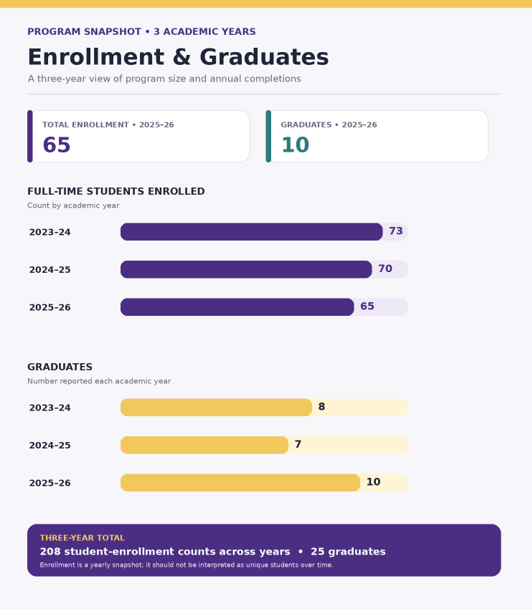
BS FTC Fall 2023- Spring 2026 Enrollment and Graduation data
The FTC program has maintained a strong student enrollment, with 65 full-time students enrolled in 2025–26. Over the past three academic years, annual enrollment counts totaled 208, while the program awarded 25 degrees. Graduations increased from 7 in 2024–25 to 10 in 2025–26, highlighting the program’s continued success in preparing students for careers in forensic and toxicological chemistry.
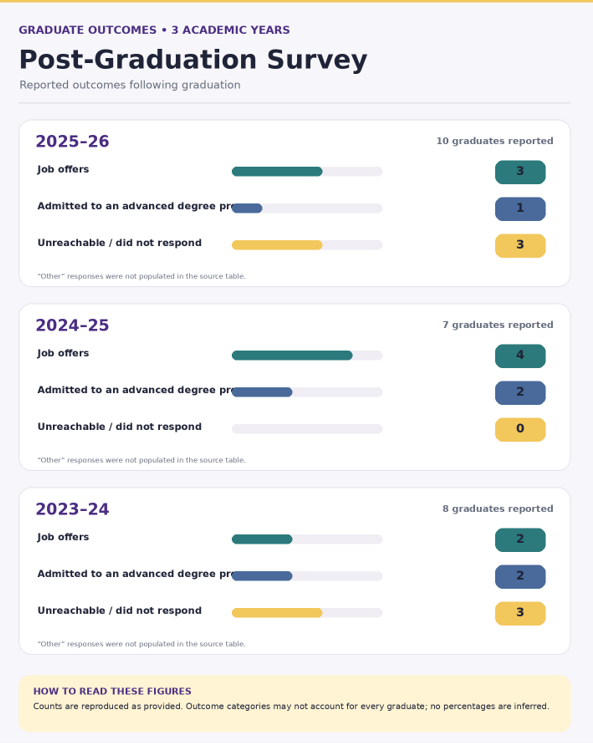
BS FTC: Fall 2023-Spring 2026 Alumni Survey
The FTC program’s post-graduation survey highlights positive career and educational outcomes among its graduates. Over the past three academic years, reported outcomes included 9 graduates receiving job offers and 5 being admitted to advanced degree programs. While some graduates could not be reached or did not respond to the survey, these results demonstrate the program’s role in preparing students for professional careers and continued education in forensic and toxicological chemistry and related fields.
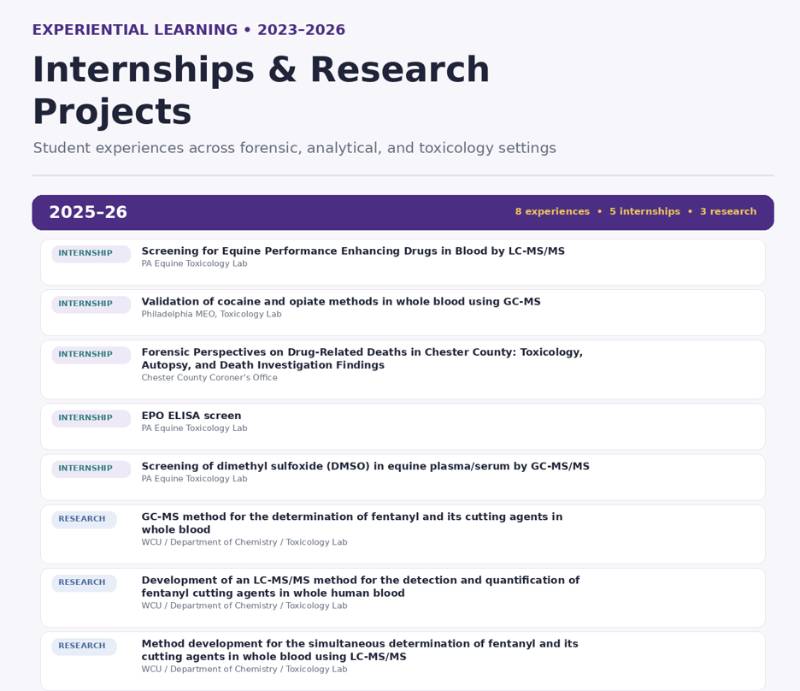
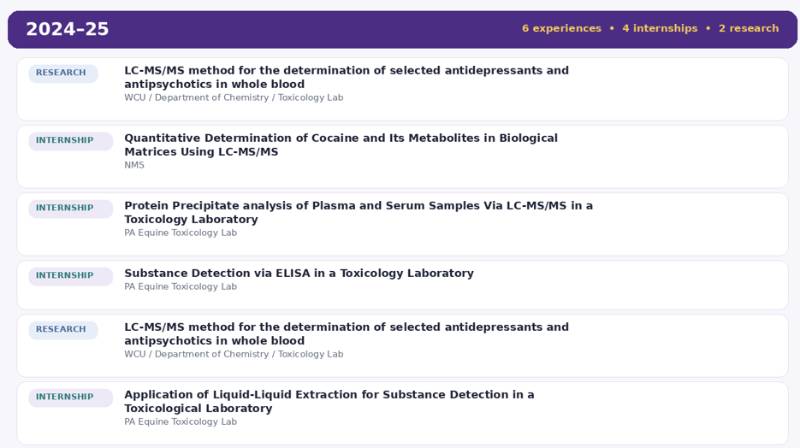
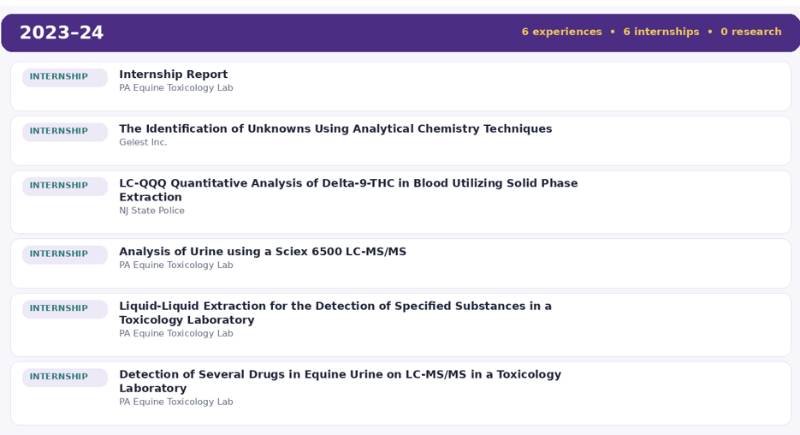
BS FTC: Fall 2023- Spring 2026 Internship & Capstone Research Projects
The FTC program offers students hands-on experience through internships and capstone research projects in forensic science, analytical chemistry, and toxicology. From 2023 to 2026, students engaged in 20 experiential learning opportunities with forensic laboratories, law enforcement agencies, and WCU research facilities, developing practical laboratory skills using advanced techniques such as GC-MS and LC-MS/MS to prepare for careers or graduate study.
Press Enter to add more content
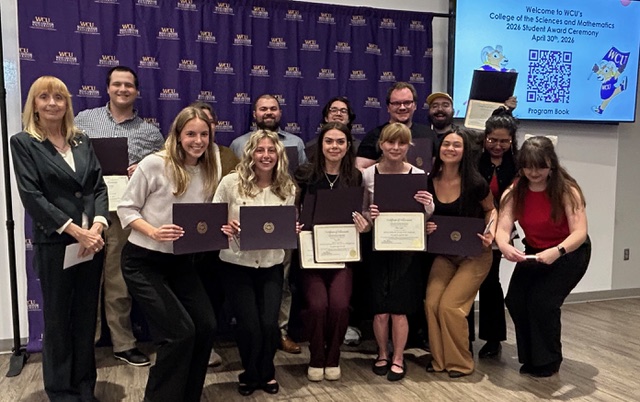
Student Award Winners 2026
Chemistry Student Awards
Pharmaceutical Product Development Student Awards

ACS Scholastic Achievement Award
Paige Ickes, Jordan Kautzsch
AIC Chemistry Award
Christopher Brunozzi
AIC Biochemistry Award
Megan St. Jean, Jillian Snyder, Lisa Travis
ACS Organic Chemistry Award
Samuel Miller
ACS Analytical Chemistry Award
Paige Ickes
ACS Physical Chemistry Award
Katherine Drummond
ACS Inorganic Chemistry Award
Jacob Gallahan
Reid-Fenton Award
Revathi Variar and Caitlynn Szarko
Chemistry Minor Award
Sean Donovan and Abigail Edelman
FTC students: 2021- 2026 Capstone Chemistry Seminar Presentation Topics
- Kratom
- The chemistry of a new adulterant found in forensic samples: Metonitazene
- Effects and pathways on human tissue by xylazine
- Performance of fentanyl test wipes based on eosin Y dye
- Development of Separation Method of Tricyclic Antidepressants and Antipsychotics Using LC- MS/MS
- Medetomidine as an Emerging Adulterant: Investigating its Role in the Fentanyl-Contaminated Drug Supply
- LC/QQQ Quantitative Analysis of Delta-9THC in Blood Utilizing Solid Phase Extraction
- Tianeptine, New Drug with Dangerously High Potential for Abuse
- Gas Chromatography-Vacuum Ultraviolet Spectroscopy (GC-VUV) Analysis of Nitazene
- Tianeptine, an Antidepressant with Opioid Agonist Effects
- New Biomarker for Monitoring Alcohol Abstinence: Phosphatidylethanol
- Toxicity of Vaping Vitamin E Acetate and Tetrahydrocannabinol Oil
- Development and Validation of a HS-GC-FID Method for Blood-Alcohol Analysis
- Identification of new designer benzodiazepines in illicit drug market: Bromazolam
- Biomarkers of Air Pollution in Post-Mortem Cellular Observation
- Analytical Characterization of Novel Benzodiazepines
- Detection of drugs of abuse through Wastewater Analysis
- N-Desethyl Isotonitazene: A Newly Identified Novel Psychoactive Substance in the United States
- The Identification of Synthetic Cannabinoids in Trafficking
- The Production of Purine-Free Beer
- Study and synthesis of diarylnornornadiene and the progress towards a viable solar energy storage
- The Emergence & Analytical Challenges of Designer Benzodiazepines
- Fentanyl Analogs: Synthesis, Metabolism, and the Rising Threat to Society
- Emerging Methods for the Analysis of Phenethylamines
- The Toxicology of Kratom
- Transdermal Fentanyl: Uses in Modern Medicine
- The Structure-Activity Relationship of the Psychedelic Drug LSD
- The chemistry of new synthetic cannabinoids: AD-18, 5F-MDA-19 and pentyl MDA-19
- Application of Thermal Desorption Sample Introduction for Trace Analysis of Volatiles and Semi-volatiles
- Development and Validation of a GC-QQQ Method for Smokeless Powder Additives
- The chemistry of commercially available drug tests: cannabis
- Identification of Volatile components in the Headspace of Pharmaceutical-grade Fentanyl
- HPLC-PDA method for the determination of cannabinoids profile in cannabis hemp edibles
- Synthesis of a PROTAC for the degradation of LRRK2


